How to compare unit prices at the grocery store
The smallest number on a shelf tag can help you compare grocery packages. Here’s how to read it, check the math and choose an amount you can use.
In this guide
Look for the small number
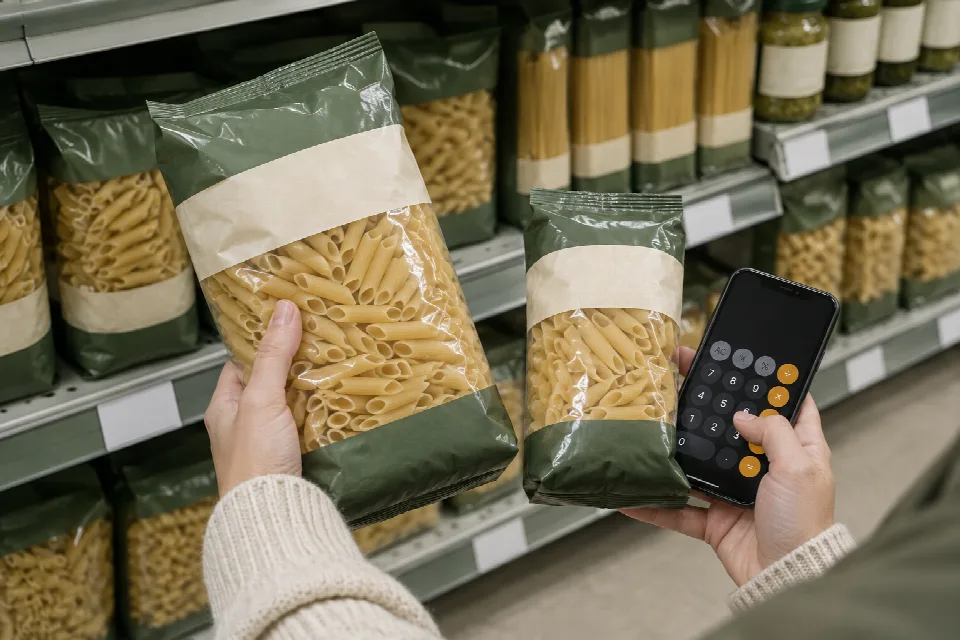
Two boxes, two sizes, two prices. Which one is the better deal? Start with the unit price: the cost for a set amount, such as one ounce or one item. It gives you a way to compare packages of different sizes. Once you know where to look, you can check the numbers and get on with your shopping.
Read the shelf tag
First, find the price for the whole package. This is the amount you’ll pay for that item before any qualifying coupon or discount. On many shelf tags, it’s the larger number.
Next, look for the smaller unit price beside or below it. Read the little words next to the number, too. They tell you what amount the price covers: an ounce, a pound, a liter or an individual item, for example.
Make sure the shelf tag matches the product in your hand. Check the name and package size before comparing it with another option. The big number tells you what goes on your bill; the small one helps you compare.
Match the units
Here’s the catch: unit prices are useful to compare only when they use the same unit. Line up price per ounce with price per ounce, or price per item with price per item.
If one tag shows a price per pound and another shows a price per ounce, convert one before you compare. There are 16 ounces in a pound. To turn a price per pound into a price per ounce, divide it by 16. Now both prices speak the same language.
Take an extra moment with items sold by count. A price per item is a handy comparison when the items are similar, but it won’t tell you everything about their size or quality. Check the package details as well.
Do the quick math
No unit price on the tag? Your phone calculator can step in. Divide the package price by the quantity in the package. The result is the price for one unit.
Before you tap, check the package size and the unit it uses. If you’re comparing ounces, use the number of ounces. If you’re comparing individual items, use the item count. Then do the same for the other package, using the same unit.
You don’t have to calculate every option on the shelf. Pick the products you would actually buy, compare those and move along.
Check the deal, not just the tag
A shelf tag is a starting point, not the whole story. If you have a coupon or see a discount, check that the product and quantity qualify. Apply the discount to the package price, then divide by the quantity to compare unit prices again.
Look at the total you’ll pay, too. If an offer requires you to buy more than one package, make sure you want that amount and check the total for all of them. A lower price per unit isn’t much help if the purchase doesn’t fit your budget.
When available, check the price history to put the current price in context. You can also look at the return policy before buying, especially if you’re trying something new or buying a larger amount.
Think beyond the biggest pack
A big package can have a lower unit price, but it isn’t automatically the better choice. Compare different sizes and brands. If fresh and frozen options both fit what you need, compare those too.
Then give the numbers a reality check. Do you like the product? Will you use it before it passes its best? Do you have room to store it? A smaller package may make more sense for your household, even if its unit price is higher.
Quality matters, too. If one option works better for your meals, that’s worth weighing alongside the unit price. The goal isn’t to win a math contest in the cereal aisle. It’s to choose a product and amount that work for you.
Spot it
- Find the unit price on the matching shelf tag, or calculate it using the package price and quantity.
- Match the units before you compare.
- Check whether coupons apply, then look at the total cost.
- Look at the price history and return policy when available.
- Choose an amount you can use and a product that meets your needs.
Sources
- www.consumerreports.org · /money/grocery-stores-supermarkets/save-money-with-unit-pricing-a8426386708
- www.thekitchn.com · /grocery-shopping-unit-price-tip-23509298
- www.wikihow.com · /Calculate-and-Compare-Unit-Prices-at-the-Store
- www.ndsu.edu · /agriculture/extension/publications/pinchin-pennie-kitchen-6-tips-save-money-unit-pricing
- www.consumer.org.nz · /articles/unit-pricing-the-secret-to-saving-at-the-supermarket