
How to choose cookware that works with your stove
A good-looking pan is only a good buy if it works on your stove. Here’s how to check the base, the label and the deal before you buy.
In this guide
Start with the bottom of the pan, not the shiny handle. A flat, steady base is a useful thing to look for, and if you have an induction stove, that base needs to be magnetic. The right match can help you avoid buying cookware that doesn’t work with your stove.
Not sure where to begin? Identify your stove, check the pan’s label and take a closer look at its base. Then decide whether the deal fits the way you cook.
Match your pan to your stove
Your stove is the first clue. Gas, electric coil, smooth-top electric and induction cooktops don’t all have the same cookware needs. A pan that works on one may not be the best match for another.
- Gas: Look for a pan that sits steadily over the burner.
- Electric coil or smooth-top electric: Look for a flat, non-warped bottom.
- Induction: Look for a magnetic base and an induction-compatible label.
Before shopping, check your stove’s manual or model information if you’re unsure what kind you have. A smooth surface alone doesn’t tell you whether it’s induction or another kind of electric cooktop.
If you want cookware you can use across stove types, check for explicit multi-cooktop labeling. Magnetic-base stainless steel and cast iron are options mentioned for gas, electric and induction cooking. Still, check the individual pan’s label rather than assuming every piece in a set is compatible.
Put induction pans to the magnet test
Induction cooking uses a magnetic field, so the pan needs a magnetic base. Cast iron, carbon steel and magnetic stainless steel are among the materials that can work. Pure aluminum, copper, glass and ceramic generally need a bonded magnetic base to work on induction.
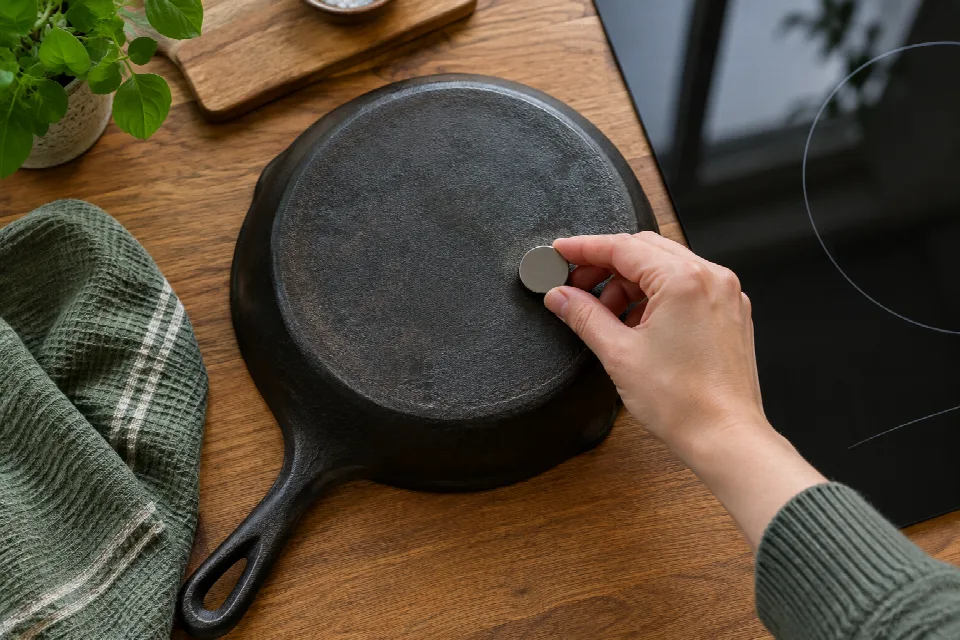
Here’s a quick check: Hold a fridge magnet against the bottom of the pan. It should stick firmly. Try the center and edges of the base. A weak pull or no pull can mean the pan won’t heat properly, or won’t heat at all.
Also look for “induction-friendly,” a coil symbol or a clear statement that the pan works on induction. Some pans have a magnetic layer or disc even if the rest of the pan is made from another material. A label helps you check the whole product, not just its name.
Shopping online? You may not be able to try the magnet test before ordering. Read the product details, and check the return terms in case the pan isn’t a match. If you’re buying a set, look for compatibility information for each piece.
Pick a steady base for gas
Gas gives you plenty of material options. Stainless steel, cast iron, copper, aluminum and carbon steel can all work on a gas stove. That means you can focus on the pan’s shape, feel and the jobs you want it to do.
Look for a flat base that sits steadily on the grate. A stable base can help with even heating and reduce hot spots from the flames. If you can inspect a pan in person, set it on a flat surface and check whether it rocks.
Think about how you’ll use it, too. Do you reach for one skillet most days, or do you need a pot as well? A big set isn’t automatically the right choice if several pieces would stay in the cabinet.
Check the bottom for electric stoves
For electric coils and smooth-top electric stoves, flatness matters. A flat, non-warped bottom makes contact with the cooking surface and helps transfer heat evenly. A wobbly or round-bottomed pan is not the match to look for here.
Stainless steel, cast iron, enameled cast iron and hard-anodized aluminum are among the options listed for electric stoves. Check the pan and stove instructions, especially for a smooth top, where you’ll also want to avoid scratching the surface.
Inspect the base before you buy if you can. If you’re ordering online, look for a clear description of the bottom and compatibility with your cooktop. Don’t be shy about passing on a listing that leaves you guessing.
Size up a cookware deal
Once the pan passes the stove test, it’s time to inspect the offer. A set can look tempting, but count the pieces you’ll actually use. Check which lids are included and whether the sizes suit the meals you make.
Compare the total cost with buying the pieces you need separately. Include shipping or other fees shown at checkout, and read the return terms before ordering. If you’re comparing two listings, make sure they contain the same pieces and sizes.
If a seller advertises a discount, check the current price against other listings or a price-history tool where available. You’re looking for a pan that fits your stove and your routine—not just a number that looks good on a tag.
Spot it
- Identify your stove type before choosing cookware.
- For induction, check the label and test the base with a magnet when you can.
- For gas, look for a flat, steady base.
- For electric, check for a flat, non-warped bottom.
- Count the useful pieces, compare the total cost and read the return terms.
Sources
- gardeningbeyond.com · /how-to-choose-the-right-cookware-pans-for-your-stove-type
- copper-mart.com · /blogs/copper-journal/cookware-stove-compatibility-gas-induction-electric
- madeincookware.com · /blogs/best-induction-cookware
- www.asaicookware.com · /blogs/asai-science/best-cookware-for-gas-and-induction
- kitchenpanguide.com · /induction-cookware-magnet-tests
- www.vikingculinaryproducts.com · /blogs/articles/best-cookware-gas-electric-induction-stoves
- prudentreviews.com · /best-cookware-for-electric-stoves
- www.mahaakitchenware.com · /blogs/news/gas-vs-induction-vs-electric-choosing-the-right-cookware-compatibility
- madeincookware.com · /blogs/what-type-of-cookware-is-best-for-induction-cooking
- gardeningbeyond.com · /how-to-know-if-cookware-is-induction