
How much laundry detergent do you really need?
Start with the detergent label, then measure for your washer and load. A little checking can help you avoid waste and compare bottles more fairly.
In this guide
The answer starts on your detergent label, not at the top of the cap. Look for the dose for your washer and load, then measure it. Filling the cap without checking could mean pouring in more than you need.
More detergent isn’t always the ticket to cleaner clothes. Too much can leave residue on laundry and buildup in your machine. Here’s how to find your starting dose, check the results and size up a detergent deal.
Start with the label, not the cap
Before you pour, find the directions on your detergent container. Check the recommended amount for your load size and how dirty the clothes are. The amount can also depend on your water: the guidance in the research suggests using less for soft water and slightly more for hard water.
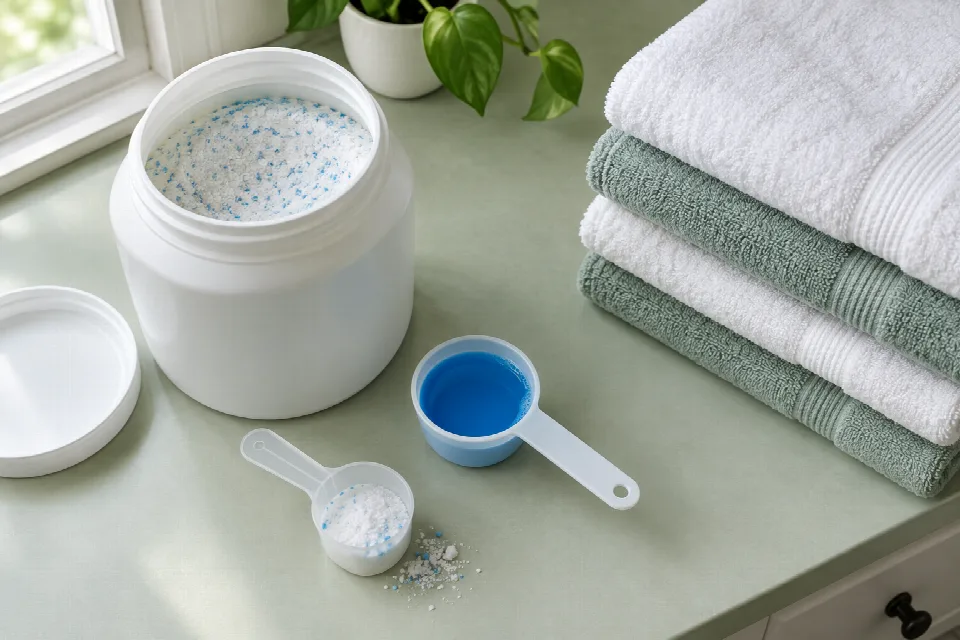
The cap is a measuring tool, not a challenge to fill it. Look for the line that matches your dose rather than filling it to the brim. If the marks are hard to read, a measuring spoon can help you see how much you’re using.
Changing detergents? Read the new label, even if the bottles look similar. A concentrated formula may call for a different amount than the one you’re used to.
Match your dose to your washer and load
Check whether your washer is a high-efficiency, or HE, model. Use HE detergent in an HE washer, and follow the product and machine directions. For a normal HE load, some sources suggest about 1 to 2 tablespoons of liquid detergent as a general starting point. Your product’s directions still come first, especially for a concentrated formula.
For a traditional washer, one source suggests about 2 tablespoons of liquid or powder as a general guide. Again, check your own label rather than treating that amount as a rule for every product.
Now look at the laundry in front of you. A small, lightly soiled load may need less than a large or heavily soiled one. If the label gives different amounts, pick the one that fits your load rather than automatically choosing the largest dose.
Measure liquid, powder and pods
Each format has its own measuring routine. The goal is the same: know what you’re adding instead of guessing.
- Liquid: Find the right line on the cap, or use a measuring spoon for the amount on the label. Pour to that mark instead of filling the cap.
- Powder: Check the label and measure the amount it specifies. Don’t assume a scoop from another product is the right size.
- Pods or pacs: Check the package for the number to use. One source suggests one for a standard load, with up to two for a large or heavily soiled load.
Keep your measuring routine easy to repeat. Once you know the right mark for your usual load, you won’t need to rethink every pour. Just revisit the label when your detergent or laundry needs change.
Check your clothes and adjust
After washing, take a look at the results. Clothes that feel stiff or have a film may be a sign that you’re using too much detergent. Too much can also create excess suds and leave buildup in the machine.
If you’ve been eyeballing a generous pour, try measuring the label’s amount for your next similar load. Check how the clothes come out. If you see residue, review the directions and consider a smaller dose where the label allows it.
If clothes aren’t getting clean, check the load size, soil level and product directions before changing your dose. Adjust for those conditions, then check the next load. You’re looking for a repeatable amount that works for your laundry, not a one-size-fits-all number.
Compare detergent deals by cost per load
A big bottle can catch your eye, but the useful question is how much you’ll use each time. Check the price and the stated number of loads on each package. Divide the price by the number of loads to get the advertised cost per load.
Then check what that load count assumes. If your usual dose differs from the one used for the package count, your own cost per load will differ too. For liquid or powder, you can estimate your load count by dividing the amount in the package by the amount you use per load, using the same units for both.
For pods, divide the number in the package by the number you normally use per load. Then divide the package price by that estimated load count. Compare products using the dose you’d actually need for each one—not just the size of the container.
The math is an estimate, since your loads can vary. But it gives you a sharper way to compare packages than judging by bottle size alone.
Spot it
- Read the detergent label and check your washer type.
- Match the dose to the load, soil level and water conditions.
- Measure instead of filling the cap by eye.
- Check clean clothes for film or stiffness and adjust as directed.
- Compare deals using your estimated cost per load.
Sources
- www.ncconsumer.org · /news-articles-eg/the-dirty-truth-about-laundry-detergent-why-using-too-much-can-cost-you-more-than-you-think.html
- www.goodhousekeeping.com · /home/cleaning/a73289957/what-happens-when-you-use-too-much-detergent
- www.realsimple.com · /how-much-laundry-detergent-to-use-7368233
- launderwise.com · /blog/how-much-laundry-detergent-to-use
- careonova.com · /how-much-detergent-to-use
- www.miamiherald.com · /living/article315743362.html
- www.marthastewart.com · /how-much-detergent-to-use-8713931
- www.laundriii.com · /blog/how-much-laundry-detergent
- www.star-telegram.com · /entertainment/living/article315743420.html